
Building wealth is not always about earning a massive salary or making risky investments. In reality, one of the most powerful financial tools available to everyone is compound interest. Often called the “eighth wonder of the world,” compound interest allows your money to grow not only on your original investment but also on the returns it has already earned.
Whether you are just beginning your financial journey or planning for retirement, understanding how compound interest works can help you make smarter decisions that benefit you for decades. The earlier you start, the more time your money has to multiply, making long-term wealth creation achievable even with modest monthly investments.
In this guide, we’ll explore how compound interest works, why time matters more than investment size, and practical ways to use it to build lasting financial security.
What Is Compound Interest?
Compound interest is the interest earned on both your initial investment (called the principal) and the accumulated interest from previous periods.
Unlike simple interest, which only pays interest on the principal amount, compound interest continuously increases your earning potential because each new interest payment becomes part of the balance that earns future interest.
Simple Formula for Compound Interest
A = P (1 + r/n)^(nt)
Where:
- A = Final amount
- P = Principal investment
- r = Annual interest rate
- n = Number of times interest compounds each year
- t = Number of years
While the formula looks technical, modern investment platforms and banks calculate it automatically.
Why Compound Interest Is Called the Snowball Effect
Imagine rolling a small snowball down a snowy hill.
At first, it grows slowly.
As it rolls farther, it collects more snow.
Eventually, it becomes much larger because every new layer helps gather even more snow.
Compound interest works in exactly the same way.
Your investment earns returns.
Those returns begin earning additional returns.
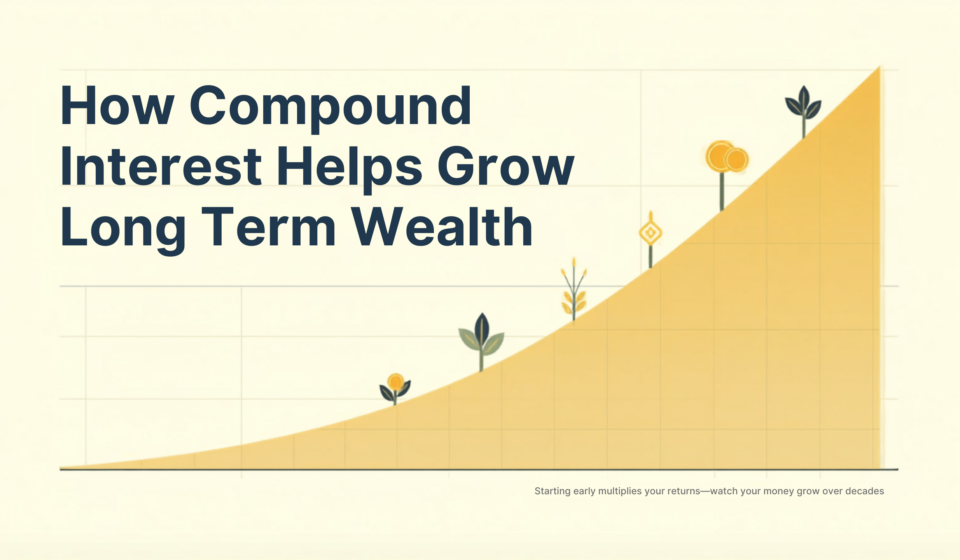
Over time, growth accelerates.
The longer the investment remains untouched, the bigger the effect becomes.
How Compound Interest Helps Grow Long Term Wealth
Compound interest creates wealth because it rewards patience.
Instead of relying on frequent buying and selling, investors benefit simply by allowing their investments to remain invested.
Several factors contribute to this growth.
Time Is Your Greatest Advantage
Time is the biggest factor in compounding.
Even small investments made early often outperform larger investments started later.
For example:
- Investor A starts investing ₹5,000 every month at age 25.
- Investor B starts investing ₹10,000 every month at age 35.
Despite investing less money overall, Investor A may accumulate more wealth by retirement because the investments had an additional decade to compound.
This illustrates why financial planners consistently encourage early investing.
Earnings Generate More Earnings
Every year your investment grows, the profits stay invested.
Instead of withdrawing gains, they become part of your investment.
The next year’s returns are calculated on the larger balance.
This cycle repeats continuously.
Eventually, annual gains become much larger than the original contributions.
Inflation Becomes Easier to Beat
Inflation gradually reduces purchasing power.
Money sitting in a regular savings account often grows slower than inflation.
Long-term investments benefiting from compound interest have historically provided higher returns that may help investors preserve and increase purchasing power over time.
Understanding the Difference Between Simple and Compound Interest
| Feature | Simple Interest | Compound Interest |
|---|---|---|
| Interest calculated on | Original amount only | Original amount plus earned interest |
| Growth speed | Linear | Exponential |
| Best suited for | Short-term loans | Long-term investing |
| Wealth-building potential | Limited | Very high |
This difference becomes dramatic over long investment periods.
The Earlier You Start, the Better
One of the biggest lessons in personal finance is that waiting can be expensive.
Consider these examples.
Scenario One
Monthly investment: ₹3,000
Investment period: 35 years
Average annual return: 12%
Estimated final value could exceed ₹2 crore.
Scenario Two
Monthly investment: ₹3,000
Investment period: 20 years
Same return
Estimated final value may only reach around ₹30 lakh.
Although both investors contributed the same monthly amount, the additional years created a significantly larger portfolio because of compounding.
Real Life Example of Compound Interest
Meet Priya, a 24-year-old software engineer.
She decides to invest ₹4,000 every month into a diversified equity mutual fund.
Instead of trying to predict market highs and lows, she invests consistently through a Systematic Investment Plan (SIP).
Some years the market rises.
Some years it falls.
She continues investing.
After 25 years, her investment has grown substantially because each year’s gains remain invested and continue generating additional returns.
Priya’s wealth was built not through extraordinary income but through consistency, patience, and compound growth.
Factors That Influence Compound Interest
Several variables determine how quickly investments grow.
Initial Investment
Starting with more money provides a larger foundation.
However, even small investments can become significant over long periods.
Regular Contributions
Monthly investments consistently increase the amount available for compounding.
Automatic investing removes emotional decision-making.
Interest Rate or Investment Return
Higher long-term returns generally produce greater growth.
However, higher expected returns often involve higher investment risk.
Maintaining a diversified portfolio helps balance growth potential with risk management.
Compounding Frequency
Interest can compound:
- Daily
- Monthly
- Quarterly
- Semi-annually
- Annually
More frequent compounding generally results in slightly higher returns.
Investment Duration
This remains the most powerful factor.
More years mean more compounding cycles.
Where Compound Interest Works Best
Compound interest can benefit various financial products.
Mutual Funds
Long-term equity mutual funds allow investments to grow over decades.
Reinvested gains increase future earning potential.
Public Provident Fund (PPF)
PPF offers government-backed long-term savings with annual compounding, making it popular for retirement planning.
Employee Provident Fund (EPF)
EPF helps salaried employees accumulate retirement savings through regular contributions and compound growth.
National Pension System (NPS)
NPS combines disciplined investing with long-term compounding for retirement goals.
Stocks
Companies that consistently increase earnings and reinvest profits may generate substantial long-term shareholder returns.
Dividend reinvestment further strengthens compounding.
Fixed Deposits
Certain fixed deposits offer compound interest, although returns may be lower than long-term equity investments.
How SIPs Benefit from Compound Interest
A Systematic Investment Plan allows investors to contribute fixed amounts regularly.
This approach offers several advantages.
Consistency
Investing every month builds financial discipline.
Rupee Cost Averaging
Buying more units during market declines and fewer during market highs may reduce the average purchase cost over time.
Long Investment Horizon
SIPs give investments years to compound.
This combination makes SIPs one of the most popular long-term wealth-building strategies.
Common Mistakes That Reduce Compound Growth
Many investors unknowingly interrupt compounding.
Starting Too Late
Every year of delay reduces future earning potential.
Frequently Withdrawing Investments
Removing money interrupts the compounding process.
Chasing Quick Profits
Constant buying and selling often reduces long-term returns through taxes, fees, and poor timing.
Ignoring Inflation
Keeping all savings in low-interest accounts may not generate sufficient long-term growth.
Panic Selling During Market Declines
Markets naturally experience volatility.
Selling during downturns prevents investors from benefiting from future recoveries and continued compounding.
Practical Tips to Maximize Compound Interest
Start Immediately
Even small monthly investments can make a meaningful difference over decades.
Invest Consistently
Automate investments whenever possible.
Consistency often matters more than timing.
Increase Contributions Regularly
Whenever income increases, consider increasing investment amounts.
Even small annual increases can significantly improve long-term wealth.
Stay Invested
Avoid reacting emotionally to short-term market movements.
Long-term investing rewards patience.
Reinvest Earnings
Dividends, bonuses, and interest should ideally remain invested whenever appropriate for your financial goals.
Diversify Your Portfolio
Diversification helps reduce unnecessary risk while maintaining long-term growth opportunities.
Compound Interest and Retirement Planning
Retirement planning depends heavily on compound interest.
Individuals who begin saving early often need to invest less each month compared to those who start later.
For example:
A 25-year-old investing consistently for 35 years may accumulate substantially more retirement savings than someone who begins at age 40, even if the second investor contributes larger monthly amounts.
This highlights the value of beginning as early as possible.
Psychological Benefits of Long-Term Investing
Compound interest also supports healthier financial habits.
Investors become less focused on daily market fluctuations.
Instead, they concentrate on:
- Long-term goals
- Consistent saving
- Financial discipline
- Patience
- Sustainable wealth creation
These habits often contribute to better financial decision-making throughout life.
Frequently Asked Questions
How does compound interest help build wealth?
Compound interest allows both your original investment and accumulated earnings to generate additional returns over time, leading to exponential growth.
Is compound interest better than simple interest?
Yes. Compound interest generally creates much greater long-term wealth because earnings continue generating future earnings.
How early should I start investing?
Starting as early as possible gives your investments more time to compound, making it easier to achieve long-term financial goals.
Can small investments really grow significantly?
Yes. Even modest monthly contributions can become substantial over several decades due to the power of compounding.
Does compound interest guarantee profits?
No. Investments linked to financial markets can fluctuate, and returns are not guaranteed. However, historically, long-term investing has benefited from the effects of compounding despite periods of market volatility.
Compound interest is one of the most effective tools for building long-term wealth because it rewards consistency, patience, and time. Rather than relying on large one-time investments or attempting to predict market movements, investors can steadily grow their wealth by making regular contributions and allowing earnings to remain invested.
Whether your goal is financial independence, buying a home, funding a child’s education, or preparing for retirement, understanding how compound interest works can transform your approach to saving and investing. The key is to start as early as possible, remain disciplined during market ups and downs, and give your investments enough time to benefit from the remarkable power of compounding. Over the years, even small, consistent actions can lead to meaningful financial growth and greater long-term security.

sahithya
Sahithya is a content writer specializing in digital content and online research. She is passionate about creating accurate, easy-to-understand articles that help readers make informed decisions. Every article is researched using trusted sources and official references, and is reviewed periodically to keep the information accurate and up to date