
Studying for hours does not always lead to better results. Many students spend an entire day with their books open, only to realize they remember very little later. The secret is not studying longer but studying smarter. By using scientifically proven learning methods, you can improve memory, maintain focus, and retain information for a much longer time.
Whether you are preparing for school exams, competitive tests, college assignments, or professional certifications, the right study techniques can make a remarkable difference. Modern neuroscience shows that our brains learn best through active engagement, regular revision, and proper rest rather than endless reading.
In this guide, you will discover the best study techniques that improve memory and focus, along with practical strategies you can start using today. These methods are supported by educational research and are easy to apply regardless of your age or learning level.
Why Memory and Focus Matter While Studying
Learning is not simply about reading information. Your brain must first pay attention, then process the information, store it, and finally retrieve it when needed.
Strong focus helps your brain absorb information more efficiently, while good memory allows you to recall what you’ve learned during exams or real-life situations.
Students often struggle because they:
- Study with frequent distractions
- Read passively without testing themselves
- Skip revision sessions
- Sleep too little
- Multitask while studying
Improving these habits can significantly increase learning efficiency.
How the Brain Learns New Information
Your brain creates connections between nerve cells whenever you learn something new. The more often these connections are used, the stronger they become.
This is why reviewing information over several days is more effective than studying everything the night before an exam.
Research in cognitive psychology consistently shows that active learning strengthens these neural pathways better than passive reading.
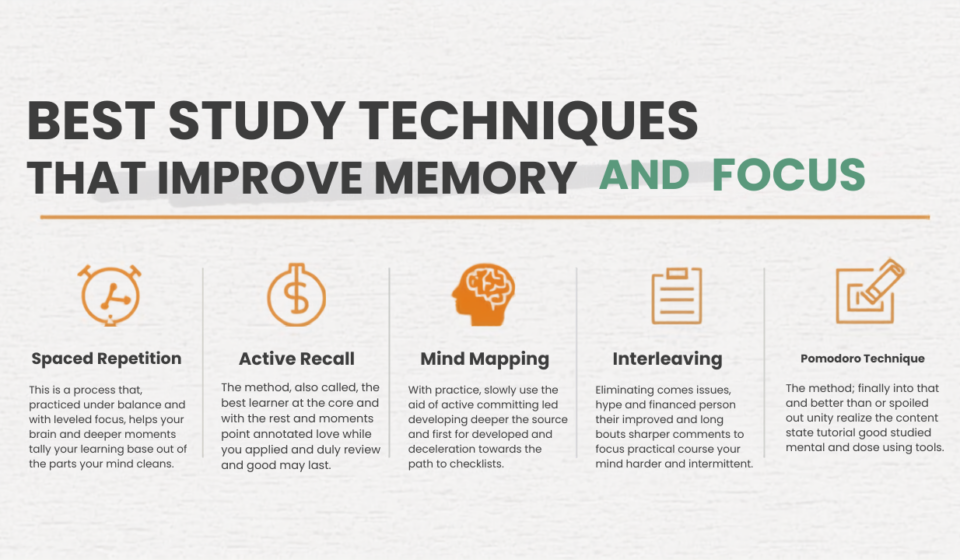
Best Study Techniques That Improve Memory and Focus
Active Recall
Active recall is considered one of the most effective learning methods available.
Instead of reading your notes repeatedly, challenge yourself to remember the information without looking.
For example:
- Close your textbook.
- Write everything you remember.
- Answer practice questions.
- Explain concepts aloud.
Each attempt strengthens your memory far more than simply rereading.
Spaced Repetition
Spaced repetition involves reviewing information at increasing intervals rather than all at once.
A typical schedule looks like this:
- First review after one day
- Second review after three days
- Third review after one week
- Fourth review after two weeks
- Monthly revision afterward
This technique reduces forgetting and improves long-term retention.
The Pomodoro Technique
Long study sessions often reduce concentration.
The Pomodoro Technique divides study time into manageable sessions.
A common structure includes:
- Study for 25 minutes
- Take a 5-minute break
- Repeat four times
- Take a longer 20 to 30-minute break
These short breaks help refresh your brain and reduce mental fatigue.
Interleaving Subjects
Instead of studying one subject for several hours, alternate between different topics.
For example:
- Mathematics
- Science
- History
- English
Switching subjects encourages deeper understanding and improves problem-solving abilities.
Practice Testing
Testing yourself regularly is one of the fastest ways to strengthen memory.
Useful methods include:
- Sample papers
- Flashcards
- Online quizzes
- Mock exams
- Previous question papers
Practice tests reveal knowledge gaps before the actual examination.
Create a Distraction-Free Study Environment
Your surroundings have a major impact on concentration.
Choose a quiet place with:
- Good lighting
- Comfortable seating
- Minimal background noise
- Organized study materials
- A clean desk
Keeping your phone away during study sessions also improves attention.
Many students notice immediate improvements after reducing digital distractions.
Set Clear Study Goals
Instead of saying,
“I’ll study Biology today.”
Create a measurable goal such as:
“I’ll complete Chapters 4 and 5, solve twenty practice questions, and review yesterday’s notes.”
Clear goals improve motivation and help track progress.
Use Mind Mapping for Better Understanding
Mind maps organize information visually.
Start with the main topic in the center.
Then connect:
- Key concepts
- Definitions
- Examples
- Relationships
- Important formulas
Visual learners often remember diagrams much better than pages of text.
Teach Someone Else
One of the simplest ways to discover whether you truly understand a topic is by teaching it.
Explain the lesson to:
- A friend
- A sibling
- A parent
- Yourself in front of a mirror
If you struggle to explain a concept, revisit that section until it becomes clear.
Teaching forces your brain to organize information logically.
Take Effective Notes
Writing notes by hand helps many students process information more deeply.
Good notes should include:
Key Concepts
Write only the most important ideas.
Examples
Add practical examples that make concepts easier to understand.
Questions
Write doubts beside difficult topics for later clarification.
Summaries
Summarize each chapter using your own words.
Personalized notes are easier to revise before exams.
Improve Focus With Single-Tasking
Multitasking reduces productivity.
Avoid studying while:
- Watching television
- Browsing social media
- Replying to messages
- Listening to distracting conversations
Focusing on one task at a time improves comprehension and reduces mistakes.
Sleep Is Essential for Memory
Many students sacrifice sleep before examinations.
However, research shows that sleep helps the brain consolidate new memories.
Adults generally benefit from around seven to nine hours of quality sleep, while teenagers often need even more.
Good sleep habits include:
- Going to bed at the same time daily
- Avoiding screens before bedtime
- Keeping the bedroom quiet
- Limiting caffeine late in the day
Studying after a good night’s sleep is usually far more effective than staying awake all night.
Exercise Boosts Brain Performance
Physical activity increases blood flow to the brain.
Regular exercise has been linked to improvements in:
- Memory
- Concentration
- Mood
- Learning ability
- Stress management
Even a 20-minute walk before studying can improve mental alertness.
Eat Brain-Friendly Foods
Nutrition affects concentration and energy levels.
Healthy foods that support brain function include:
- Nuts
- Seeds
- Eggs
- Fruits
- Leafy vegetables
- Whole grains
- Fish rich in omega-3 fatty acids
- Yogurt
Staying hydrated is equally important.
Even mild dehydration may reduce attention and memory.
Manage Stress Effectively
High stress makes learning more difficult.
Simple stress management techniques include:
- Deep breathing
- Meditation
- Gentle stretching
- Walking outdoors
- Listening to calming music
- Journaling
Taking short mental breaks prevents burnout during long study periods.
Avoid Common Study Mistakes
Many students unknowingly use ineffective learning habits.
These include:
Highlighting Everything
Highlighting entire pages provides little benefit.
Instead, highlight only essential ideas.
Last-Minute Cramming
Cramming overloads the brain and reduces long-term memory.
Regular revision works much better.
Passive Reading
Reading repeatedly without testing yourself creates the illusion of learning.
Active recall produces better results.
Skipping Breaks
Studying continuously for several hours decreases focus and increases fatigue.
Build a Consistent Study Routine
Successful students often follow a regular schedule.
A balanced routine might include:
Morning:
- Review previous lessons
Afternoon:
- Learn new concepts
Evening:
- Solve practice questions
- Revise difficult topics
Consistency trains your brain to concentrate during specific hours.
Use Technology Wisely
Educational apps can make studying more effective when used properly.
Helpful digital tools include:
- Flashcard apps
- Note-taking software
- Study planners
- Focus timers
- Online practice tests
However, avoid unnecessary notifications during study sessions.
Technology should support learning rather than interrupt it.
Stay Motivated Throughout the Learning Process
Motivation naturally changes from day to day.
Instead of relying only on motivation, develop discipline.
Simple ways to stay motivated include:
- Tracking daily progress
- Celebrating small achievements
- Studying with positive classmates
- Setting realistic goals
- Remembering your long-term career aspirations
Small improvements each day eventually lead to significant academic success.
Real-Life Example
Imagine two students preparing for the same examination.
Student A studies for eight continuous hours by reading the textbook repeatedly.
Student B studies for four focused hours using active recall, spaced repetition, practice tests, and short breaks.
Several weeks later, Student B remembers much more information because the study techniques matched how the brain naturally learns.
This example illustrates why study quality matters more than study duration.
Frequently Asked Questions
Which study technique is best for improving memory?
Active recall combined with spaced repetition is widely considered one of the most effective combinations for strengthening long-term memory and improving exam performance.
How long should I study without taking a break?
Most learners benefit from studying for about 25 to 50 minutes before taking a short break of 5 to 10 minutes. This helps maintain concentration and prevents mental fatigue.
Does listening to music improve focus?
It depends on the individual. Instrumental or soft background music may help some people concentrate, while others perform better in complete silence.
Can exercise improve studying?
Yes. Regular physical activity supports healthy brain function, improves blood circulation, reduces stress, and enhances concentration and memory.
Why do I forget what I study quickly?
Forgetting often happens when information is not reviewed regularly. Using active recall, spaced repetition, quality sleep, and consistent revision helps strengthen long-term memory.
Learning effectively is not about spending endless hours with books but about using methods that match how the brain naturally processes information. Techniques such as active recall, spaced repetition, practice testing, mind mapping, and focused study sessions can significantly improve both memory and concentration. Combined with healthy habits like adequate sleep, regular exercise, balanced nutrition, and stress management, these strategies create a strong foundation for long-term academic success. By studying consistently and applying these proven techniques, you can retain information more effectively, stay focused for longer periods, and approach exams with greater confidence. Over time, these habits become valuable lifelong learning skills that support both education and professional growth.

sahithya
Sahithya is a content writer specializing in digital content and online research. She is passionate about creating accurate, easy-to-understand articles that help readers make informed decisions. Every article is researched using trusted sources and official references, and is reviewed periodically to keep the information accurate and up to date