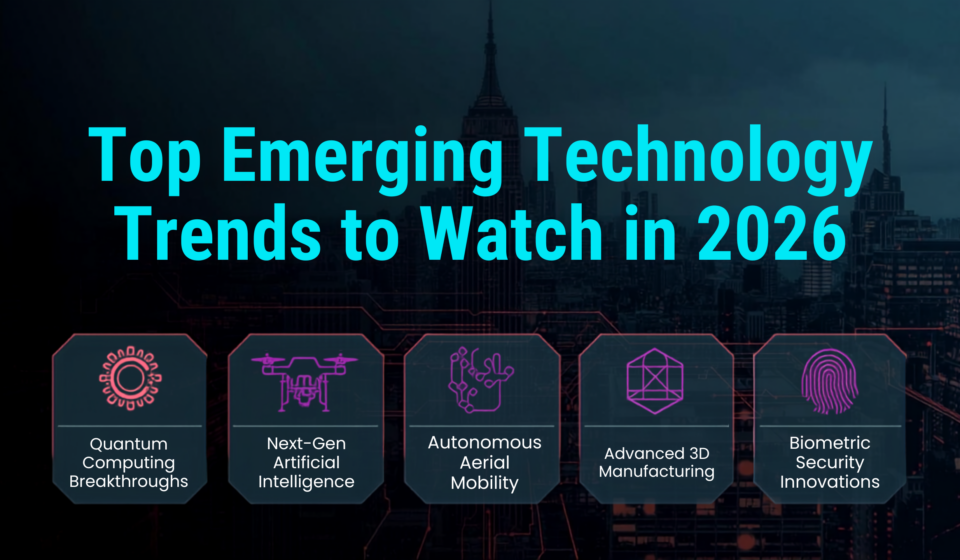

Technology is evolving faster than ever, and 2026 is shaping up to be a defining year for innovation. From artificial intelligence becoming more capable to breakthroughs in healthcare, cybersecurity, robotics, and sustainable technology, businesses and individuals are experiencing rapid digital transformation. Organizations are investing in smarter solutions that improve productivity, reduce costs, and create better customer experiences. At the same time, consumers are benefiting from more personalized services, safer digital environments, and advanced connected devices. Understanding the top emerging technology trends to watch in 2026 can help professionals, entrepreneurs, and technology enthusiasts prepare for the future and make informed decisions in an increasingly digital world.
Why Emerging Technology Matters in 2026
Every major technological shift changes the way people work, communicate, learn, shop, and receive healthcare. Companies that embrace innovation often gain a competitive advantage, while individuals with future-ready skills remain valuable in a changing job market.
According to global technology analysts, investments in artificial intelligence, cloud computing, cybersecurity, and automation continue to grow as organizations prioritize digital transformation. Governments are also supporting innovation through smart city initiatives, renewable energy projects, and digital infrastructure improvements.
These developments make 2026 an exciting year for technological advancement.
Artificial Intelligence Becomes More Intelligent
Artificial intelligence (AI) continues to dominate technology discussions, but in 2026 it is becoming more practical and integrated into everyday life rather than simply being a futuristic concept.
Modern AI systems can understand language, generate content, analyze complex data, assist developers with coding, and automate repetitive business tasks. Businesses are increasingly using AI to improve customer support, supply chain management, healthcare diagnostics, and financial analysis.
Key AI Developments
- AI-powered digital assistants become more accurate.
- Businesses automate repetitive office tasks.
- AI supports doctors in analyzing medical images.
- Retail companies personalize customer experiences.
- AI improves manufacturing quality control.
Rather than replacing workers entirely, AI is increasingly acting as a productivity partner, helping professionals complete tasks faster while allowing them to focus on strategic work.
Agentic AI Changes Workplace Productivity
One of the most talked-about innovations in 2026 is Agentic AI.
Unlike traditional AI tools that respond to single prompts, Agentic AI systems can plan, execute multiple tasks, and adapt their actions based on changing conditions.
For example, instead of simply creating a report, an AI agent may:
- Gather information from multiple sources.
- Analyze the data.
- Generate visual charts.
- Draft executive summaries.
- Schedule follow-up meetings.
This level of automation is transforming industries such as finance, healthcare, customer service, logistics, and software development.
AI Powered Cybersecurity Becomes Essential
As cyber threats become more sophisticated, cybersecurity technologies are evolving just as quickly.
Organizations now use AI-powered security platforms that monitor millions of digital events every second. These systems detect suspicious behavior much faster than traditional security software.
Major Cybersecurity Trends
Zero Trust Security
Companies verify every user and every device before granting access.
AI Threat Detection
Machine learning identifies unusual behavior that may indicate hacking attempts.
Passwordless Authentication
Biometric authentication, facial recognition, and security keys reduce reliance on traditional passwords.
Cloud Security
Organizations continue strengthening protection for cloud-based applications and remote workers.
Cybersecurity is no longer only an IT concern—it has become a business priority.
Edge Computing Expands Rapidly
Cloud computing remains important, but edge computing is gaining momentum in 2026.
Instead of sending all data to distant cloud servers, edge computing processes information closer to where it is generated.
This approach offers several advantages:
- Faster response times
- Reduced network congestion
- Improved privacy
- Lower operational costs
- Better support for real-time applications
Industries including manufacturing, healthcare, transportation, and smart cities increasingly rely on edge computing for mission-critical operations.
Quantum Computing Moves Toward Practical Applications
Quantum computing has long been considered experimental, but 2026 marks significant progress toward real-world use cases.
Although traditional computers remain dominant, quantum systems are beginning to solve highly specialized problems involving enormous amounts of data.
Researchers are exploring quantum computing for:
- Drug discovery
- Climate modeling
- Financial forecasting
- Material science
- Logistics optimization
- Advanced encryption
While widespread adoption may still take years, businesses are preparing for future opportunities created by quantum technologies.
Green Technology Gains Momentum
Sustainability has become a central focus for governments and organizations worldwide.
Green technology aims to reduce environmental impact while improving energy efficiency and supporting long-term economic growth.
Popular Green Technology Innovations
Smart Energy Management
AI helps optimize electricity consumption in homes and businesses.
Renewable Energy Storage
Improved battery technologies make solar and wind power more reliable.
Carbon Tracking Software
Organizations measure and reduce carbon emissions more accurately.
Sustainable Data Centers
Technology companies invest in energy-efficient infrastructure that reduces electricity consumption.
Businesses increasingly view sustainability as both an environmental responsibility and a competitive advantage.
Extended Reality Creates Immersive Experiences
Extended Reality (XR), which includes Virtual Reality (VR), Augmented Reality (AR), and Mixed Reality (MR), continues to evolve beyond gaming.
Companies now use immersive technologies for:
- Employee training
- Remote collaboration
- Medical education
- Product design
- Virtual tourism
- Retail shopping experiences
For example, architects can walk clients through virtual buildings before construction begins, while surgeons practice complex procedures using immersive simulations.
Robotics Become Smarter and More Collaborative
Robots are no longer limited to factory assembly lines.
Modern collaborative robots, often called cobots, work safely alongside humans.
Industries benefiting from robotics include:
- Manufacturing
- Warehousing
- Agriculture
- Healthcare
- Hospitality
- Food production
Advanced sensors, computer vision, and AI allow robots to recognize objects, navigate environments, and adapt to changing situations with greater accuracy.
Internet of Things Continues Connecting Everything
The Internet of Things (IoT) keeps expanding as billions of connected devices communicate with one another.
Examples include:
- Smart homes
- Wearable fitness devices
- Connected vehicles
- Industrial equipment
- Smart agriculture
- Healthcare monitoring systems
IoT devices collect valuable data that organizations use to improve efficiency, reduce downtime, and enhance customer experiences.
As 5G networks mature, IoT adoption continues accelerating worldwide.
Blockchain Evolves Beyond Cryptocurrency
Although blockchain technology is widely associated with cryptocurrencies, its applications continue expanding across multiple industries.
Businesses are using blockchain to improve transparency, security, and traceability.
Blockchain Applications
Supply Chain Management
Products can be tracked from manufacturing to delivery.
Digital Identity
Secure digital identities reduce fraud.
Healthcare Records
Patient information can be shared securely among authorized providers.
Smart Contracts
Automated agreements reduce paperwork and administrative delays.
These practical uses are helping blockchain mature into an enterprise technology.
Personalized Healthcare Through Technology
Healthcare innovation remains one of the most exciting technology trends of 2026.
Artificial intelligence, wearable devices, genetic research, and predictive analytics are making healthcare more personalized than ever.
Patients can now benefit from:
- Continuous health monitoring
- Early disease detection
- Remote consultations
- AI-assisted diagnostics
- Personalized treatment recommendations
Hospitals are increasingly using predictive analytics to identify high-risk patients before serious complications develop.
Digital Twins Improve Business Operations
Digital twins are virtual replicas of physical objects, factories, buildings, or entire cities.
These digital models continuously receive data from sensors, allowing organizations to monitor performance in real time.
Benefits include:
- Predictive maintenance
- Lower operational costs
- Improved equipment reliability
- Better planning
- Reduced downtime
Manufacturing, aviation, construction, and energy companies are investing heavily in digital twin technology.
6G Research Begins Shaping Future Connectivity
While many regions are still expanding 5G coverage, researchers are actively exploring 6G technologies.
Future networks are expected to deliver:
- Faster data speeds
- Ultra-low latency
- Improved AI integration
- Better satellite communication
- Enhanced support for autonomous vehicles
Although commercial deployment remains several years away, early research is influencing next-generation communication technologies.
Human Centered Technology Design
Technology companies increasingly recognize that successful innovation depends on creating products that people trust and enjoy using.
Human-centered design emphasizes:
- Privacy
- Accessibility
- Simplicity
- Inclusivity
- Ethical AI
- Transparency
Organizations that prioritize user experience often achieve higher customer satisfaction and stronger long-term loyalty.
Skills That Will Be Most Valuable in 2026
As technology advances, professionals are adapting by learning new technical and analytical skills.
Some of the most valuable skills include:
- Artificial intelligence literacy
- Data analysis
- Cloud computing
- Cybersecurity
- Software development
- Prompt engineering
- Automation management
- Critical thinking
- Digital communication
- Problem solving
Employers increasingly value professionals who combine technical expertise with creativity and strong communication abilities.
How Businesses Can Prepare for Emerging Technologies
Businesses do not need to adopt every new technology immediately. Instead, they should focus on innovations that align with their goals and customer needs.
Successful organizations often follow these strategies:
Invest in Employee Training
Continuous learning helps teams adapt to new technologies.
Strengthen Cybersecurity
Protecting digital assets remains essential as businesses become more connected.
Adopt AI Responsibly
Organizations should implement ethical AI practices while maintaining human oversight.
Modernize Infrastructure
Cloud computing, edge computing, and automation improve scalability and operational efficiency.
Prioritize Innovation
Companies that experiment responsibly often discover new opportunities before competitors.
Frequently Asked Questions
What is the biggest technology trend in 2026?
Artificial intelligence remains the most influential technology trend in 2026 because it is transforming nearly every industry, from healthcare and education to finance, retail, manufacturing, and customer service.
Which industries will benefit the most from emerging technologies?
Healthcare, finance, manufacturing, logistics, education, retail, agriculture, transportation, and energy are expected to experience significant benefits through automation, AI, cybersecurity, robotics, and data-driven decision-making.
Is quantum computing replacing traditional computers?
No. Quantum computing is designed to solve highly specialized problems that conventional computers cannot efficiently process. Traditional computers will continue handling everyday computing tasks for the foreseeable future.
Why is cybersecurity becoming more important?
As businesses increasingly rely on cloud services, connected devices, and artificial intelligence, cyber threats continue evolving. Strong cybersecurity protects sensitive information, maintains customer trust, and reduces operational risks.
How can individuals prepare for future technology trends?
Learning digital skills, staying informed about industry developments, improving AI literacy, and embracing continuous education are among the best ways to remain competitive in the rapidly changing technology landscape.
The top emerging technology trends to watch in 2026 highlight a future driven by intelligent automation, responsible artificial intelligence, stronger cybersecurity, sustainable innovation, advanced connectivity, and personalized digital experiences. Rather than existing as isolated breakthroughs, these technologies are increasingly working together to solve real-world challenges across healthcare, education, manufacturing, finance, and countless other industries. Businesses that embrace innovation thoughtfully and individuals who continue developing future-ready skills will be better positioned to thrive in an economy where technology is becoming more integrated into everyday life. Staying informed, adaptable, and open to change will be the key to making the most of the opportunities that 2026 and beyond have to offer.

sahithya
Sahithya is a content writer specializing in digital content and online research. She is passionate about creating accurate, easy-to-understand articles that help readers make informed decisions. Every article is researched using trusted sources and official references, and is reviewed periodically to keep the information accurate and up to date